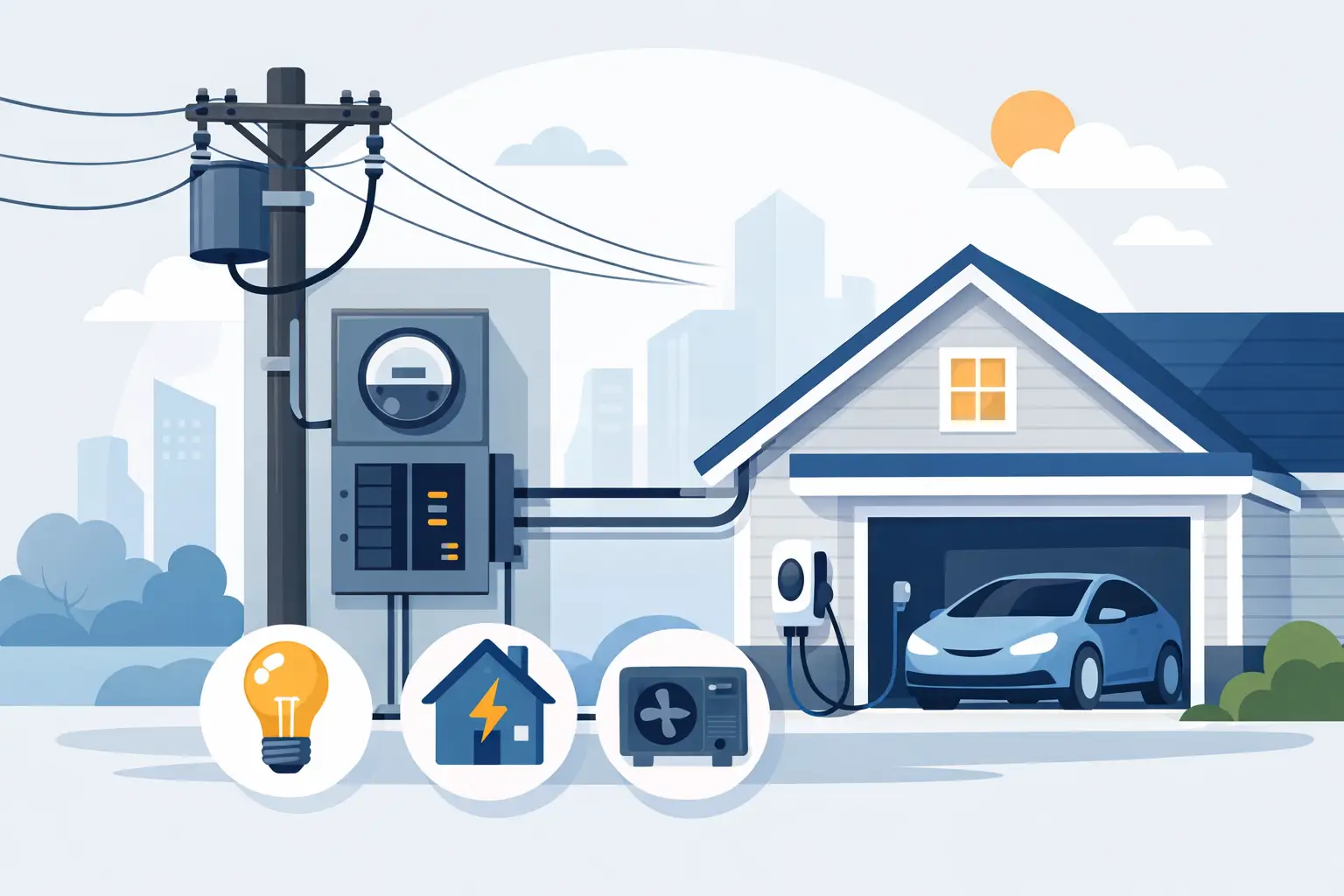
If your lights dim when the HVAC starts, your panel is full, or you’re planning an EV charger, you’re already asking the right question: how to size residential electrical service for the way your home actually uses power.
For most homeowners, service size comes up when something changes. Maybe you’re finishing a basement, replacing an old panel, adding a hot tub, or buying an electric vehicle. Maybe you’re in an older Asheville-area home with a 100-amp service and you’re not sure whether it can handle modern demand. The right answer is not a guess, and it is not based on one appliance alone. It comes from a load calculation that looks at the house as a whole.
How to size residential electrical service without guessing
Electrical service size is the amount of power your home can safely receive from the utility. In most homes, that means a main service rated at 100 amps, 150 amps, 200 amps, or sometimes more for larger properties. The panel matters, but the full service includes the meter base, service entrance conductors, grounding, and other components that all need to match the load.
A lot of homeowners assume bigger is always better. Sometimes it is, especially if you’re planning major upgrades. But oversizing for no reason can add cost, and undersizing creates the real problem – nuisance tripping, limited panel space, poor performance, and safety concerns. That is why licensed electricians use a formal calculation instead of estimating by square footage alone.
The basic idea is simple. You start with the home’s general lighting load, then add required small-appliance and laundry circuits, then account for fixed appliances and larger equipment such as ranges, dryers, water heaters, HVAC systems, well pumps, and EV chargers. After that, demand factors are applied according to code rules, because not everything runs at full power at the same time. The result tells you what service size is appropriate.
What goes into a residential service load calculation
Square footage is part of the picture, but only part. A modest home with electric heat, an electric range, an electric dryer, and a Level 2 EV charger can place more demand on the service than a larger home with natural gas heat and fewer major electric loads.
General lighting load is usually based on the home’s habitable square footage. Then there are the required kitchen small-appliance circuits and the laundry circuit, which get added as standard loads. From there, the calculation gets more specific.
Major appliances and dedicated equipment
Fixed appliances carry real weight in the calculation. That includes the dishwasher, disposal, microwave, wall oven, cooktop, dryer, water heater, and sump pump if applicable. If your home has equipment that runs on a dedicated circuit, it may affect the service size.
This is one reason service upgrades often come up during remodeling. A kitchen remodel might add a wall oven and induction cooktop. A garage upgrade might add a subpanel and EV charger. Those additions can push an older service past what makes sense.
Heating and cooling loads
HVAC often becomes the deciding factor. Electric resistance heat draws far more power than a gas furnace with a blower. Heat pumps, air handlers, mini-splits, and central air systems all have different electrical demands. In Western North Carolina, homes vary widely here. One house may use gas for heat and water heating, while another relies heavily on electric systems.
Code calculations typically consider the larger of the heating or cooling load, not both at full value together, because they do not usually operate at peak demand at the same time. That helps keep the calculation realistic, but it still needs to be done correctly.
Future loads matter too
A service size should fit not only the home you have today, but the one you’re building toward. If you know you’ll want a generator inlet, workshop circuits, a finished basement, or an EV charger in the next few years, that should be part of the conversation.
This is where homeowners get caught off guard. A panel may technically still work today, but if it has no room for expansion and the service is already close to capacity, future projects become harder and more expensive.
Common residential service sizes and what they usually mean
Many older homes still have 100-amp service. That may be adequate for a smaller home with gas appliances and limited added equipment. But it can feel tight in a modern household, especially if you have electric cooking, electric drying, a newer HVAC system, or plans for vehicle charging.
A 150-amp service can work well in some homes, but 200 amps has become the common target for many single-family residences. It gives more capacity for today’s loads and more flexibility for future upgrades. In larger homes, all-electric homes, or properties with high-demand extras such as pools, hot tubs, detached workshops, or multiple HVAC systems, even more capacity may be appropriate.
That said, there is no one-size-fits-all answer. A 200-amp panel in a house with outdated service equipment does not automatically mean you have a true 200-amp service. Homeowners sometimes see the panel rating and assume the entire system matches. A licensed electrician checks the whole setup, not just the label on the door.
Signs your current service may be too small
You do not need to wait for a complete failure before asking for a load evaluation. Certain warning signs suggest your electrical service may be stretched.
If breakers trip when large appliances run together, if lights flicker when equipment starts, or if your panel has no open spaces for new circuits, those are practical red flags. The same goes for fuse boxes, recalled panels, overheated conductors, or visible corrosion around service equipment.
Some issues point to repair rather than a full upgrade, so this is where experience matters. Flickering lights can come from loose connections, utility-side problems, or overloaded circuits. The only safe way to separate those possibilities is an on-site inspection.
Why DIY sizing gets risky fast
Homeowners can find online calculators, but most simplify the process too much. They may not reflect the latest code method, local requirements, or the real-world condition of your existing system. They also do not inspect conductor sizes, grounding, panel limitations, or utility coordination.
Sizing service is not just math on paper. It affects permits, code compliance, equipment selection, and safety. If the utility requires changes to the meter base or service mast, or if the grounding and bonding are outdated, those issues need to be handled as part of the project.
In other words, the calculation is only one piece of the job. The installation has to match it.
When to have a licensed electrician evaluate your service
If you’re adding major electrical equipment, buying an EV, renovating, or replacing an old panel, that is the time to have the load calculated. The same is true if you’re moving into an older home and you are not sure what the service can support.
A licensed electrician can review your current panel, confirm the actual service rating, inspect the service entrance equipment, and perform a residential load calculation based on the home’s square footage and installed loads. If an upgrade is needed, you can get a clearer picture of what is involved rather than making decisions based on assumptions.
For homeowners in Asheville, Arden, Candler, Weaverville, and nearby communities, this matters even more in older neighborhoods where homes may have been updated in stages over decades. A house can look modern inside while still relying on undersized or aging electrical infrastructure.
The smart way to plan ahead
If you’re wondering how to size residential electrical service, the best answer is to treat it as a planning decision, not just a repair. Think about what your home needs now, what you want to add in the next few years, and whether your existing system is giving you room to do that safely.
A careful load calculation can prevent wasted money, repeat work, and frustrating limits later. It can also help you move forward with more confidence, whether you’re adding one dedicated circuit or preparing for a full service upgrade. If you are unsure where your home stands, Asheville Electrical Contractors can help connect you with a licensed, insured electrician who can evaluate the load and recommend the right next step for your home.
Need a licensed electrician?
Talk to our team today or request a free written quote.