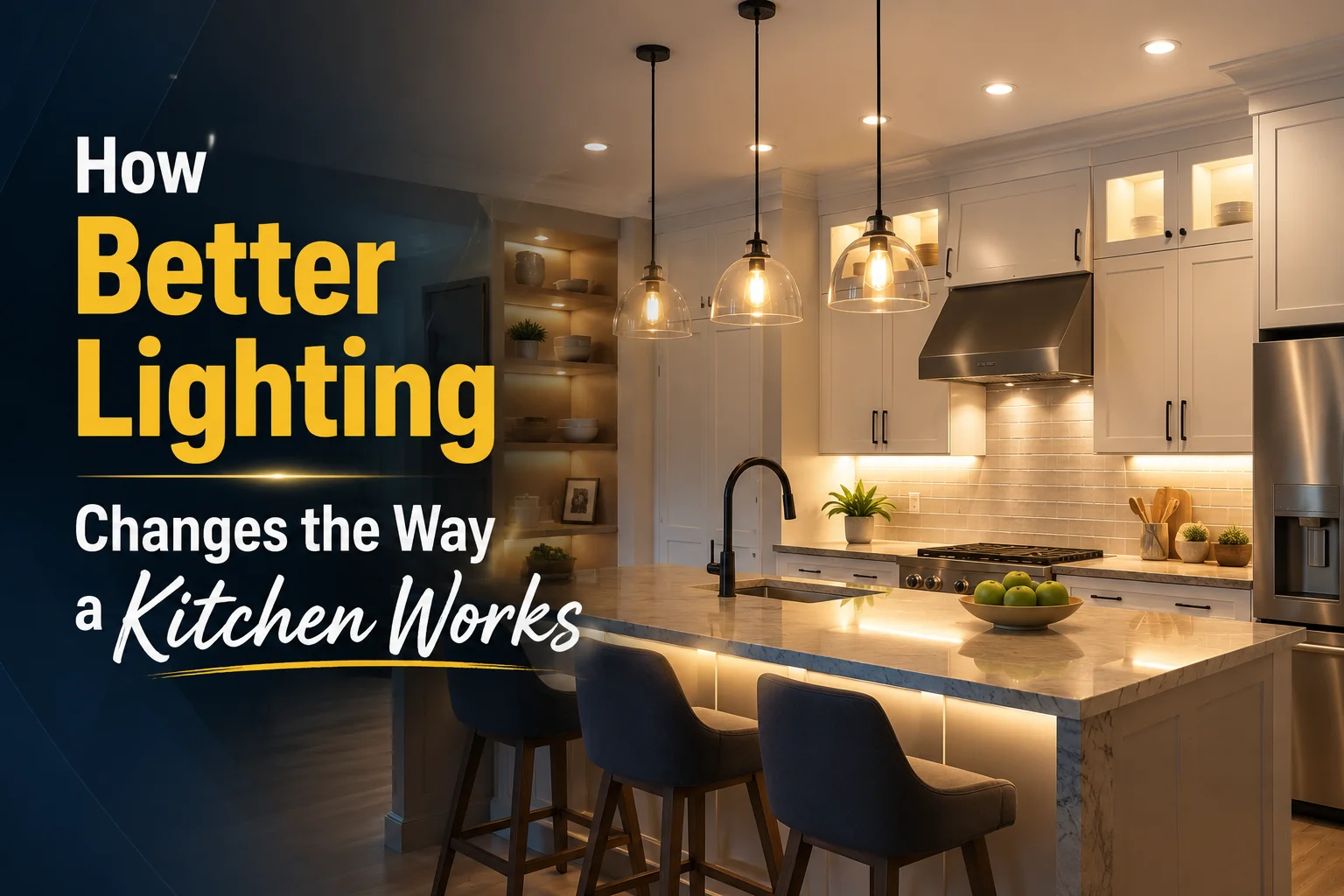
Even if the lighting fixtures and fittings are beautiful and the appliances are functional, a kitchen can still be hard to use when the lighting is inadequate. Poor lighting choices can disrupt basic tasks in the daily routine in dark workspaces and strong overhead light glare. By carefully placing under-cabinet lighting services in Asheville, we can place it closer to where it will be used most, where people cook, read recipes, clean surfaces, and work.
We also view lighting not as a final design touch but as an integral part of the kitchen’s electrical design. Task, ambient, and accent lighting can be integrated to make a well-planned kitchen lighting installation more efficient in creating a useful space. If a room requires more lighting, recessed lighting installation can provide light in more than one location while maintaining low ceiling-mounted lights.
Why does kitchen lighting need more than one light source?
One ceiling fixture does not always offer a ‘perfect lighting’ in a kitchen. Counters, sinks, islands, cooktops, and storage areas are where people work, but the user of the space may obstruct light above.
Which is why we are suggesting you consider layering lights. Task lighting aids in lighting work surfaces. Ambient lighting is used to light the room generally. Accent lighting can be used to highlight architectural details or display spaces.
The combination may be under-cabinet fixtures, recessed ceiling lights, island pendants, wall lighting, or other appropriate fixtures as dictated by the kitchen layout and electrical needs. The goal is clear: we wish to illuminate the work surface without producing unnecessary glare or shadows.
What makes under-cabinet lighting so useful?
Under-cabinet fixtures are the lights that are positioned directly above countertops. This can help make food preparation, cleaning, reading labels, and other fine details easier to see.
Under-cabinet lighting services in Asheville involve us thinking about the dimensions of the cabinets, counter depth, positioning of the fixtures, access to the wiring, switches, and how much light is needed. We also take into account whether the lights should be separate and apart from the general lighting in the room.
Another practical advantage of the modern LED options is that they are extremely easy to install. According to the U.S. Department of Energy, LED lighting is very energy efficient and can save energy compared to similar lamps, with improved durability and flexibility of brightness, colour temperature, and controls.
This doesn’t require the upgrade to be a lighting installation, but an under-cabinet upgrade can enhance visibility.
How does recessed lighting change a kitchen?
Recessed fixtures can be used to create widespread overhead coverage without taking up visual room. They can be used to help minimize dark rooms when correctly placed, and to help give even lighting on floors, counters, and circulation routes.
Ceiling height, kitchen size, cabinet layout, island location, existing wiring, and the function of each area are all taken into account during recessed lighting installation. The spacing of fixtures is also important. Crowding lights will cause unnecessary light, and the wrong placement will leave work surfaces in shadow.
We also explore switching and controls. Instead of having all kitchen lights on one switch, having them controlled individually for the general lighting, the work areas, and accent areas can be advantageous.
Can better lighting improve energy efficiency?
Yes, but the amount of savings will vary based on the fixtures, controls, operating hours, and the existing system. Lighting in buildings in the U.S. used an estimated 244 terawatt-hours of electricity per year, according to the Department of Energy’s 2020 Lighting Market Characterization.
The possibility of reducing electricity consumption adds value when using efficient fixtures, and controls can add another dimension. Basic lighting controls typically have an estimated energy savings of 24% to 38%, and a large number of commercial buildings do not have lighting controls at all. To us, this is a good reminder that efficient lighting isn’t just about the fixture. It’s also about how the system is controlled and utilized.
What should we consider before installing new kitchen lights?
We begin by looking at how the kitchen functions. A cooking area may need stronger task illumination than a breakfast nook. An island may need focused light, while circulation areas may need softer ambient coverage.
We also consider the existing electrical system before adding new fixtures or circuits. Our planning typically looks at fixture type, load requirements, circuit capacity, switch locations, wiring routes, ceiling access, controls, and the property’s existing electrical condition.
For a kitchen project, we may consider:
- Countertop task lighting for food preparation and cleanup
- Recessed fixtures for general room illumination
- Pendant or focused lighting for an island
- Under-cabinet fixtures for work surfaces
- Separate switches or dimmers for different lighting zones
- LED fixtures for efficiency and longer service life
The right combination depends on the space rather than a standard fixture package.
What should homeowners look for when planning lighting work?
We recommend looking beyond fixture style. Electrical experience, code knowledge, wiring expertise, circuit planning, and careful installation all matter.
A good lighting project should account for the entire system, including how fixtures are powered, switched, maintained, and used over time. This is particularly important when new lighting is being added to an older property.
Why is the best lighting often the lighting you barely notice?
When lighting is planned well, it supports the room without becoming a distraction. Work surfaces are easier to see. Dark corners become more usable. Fixtures operate where they are needed. The kitchen feels more balanced without relying on excessive brightness.
For Asheville-area property owners considering under-cabinet lighting services in Asheville, Morgan Master Electrician Company provides electrical capabilities that include lighting, commercial and industrial electrical work, generators, maintenance, and emergency services. Our approach is to treat lighting as part of the property’s electrical design, so improvements are not only attractive but practical, properly planned, and built around how the space is actually used.
Frequently Asked Questions
- Is under-cabinet lighting worth installing?
Yes, properly installed under-cabinet lighting can improve visibility on countertops and reduce shadows created by overhead fixtures.
- Is recessed lighting good for a kitchen?
Recessed lighting can work well for general illumination when fixture placement, spacing, ceiling conditions, and the kitchen layout are considered carefully.
- Are LED fixtures a good choice for kitchens?
LED fixtures are widely used because they can provide efficient lighting, long service life, and options for brightness and color temperature.
- Can recessed and under-cabinet lighting work together?
Yes. Using both can create layered illumination, with recessed fixtures providing general light and under-cabinet fixtures supporting countertop tasks.
- Should a professional install new kitchen lighting?
Professional installation is advisable when new wiring, circuits, switches, fixtures, or changes to the existing electrical system are involved. Proper planning helps ensure the installation suits the property’s electrical capacity and applicable requirements.
Need a licensed electrician?
Talk to our team today or request a free written quote.